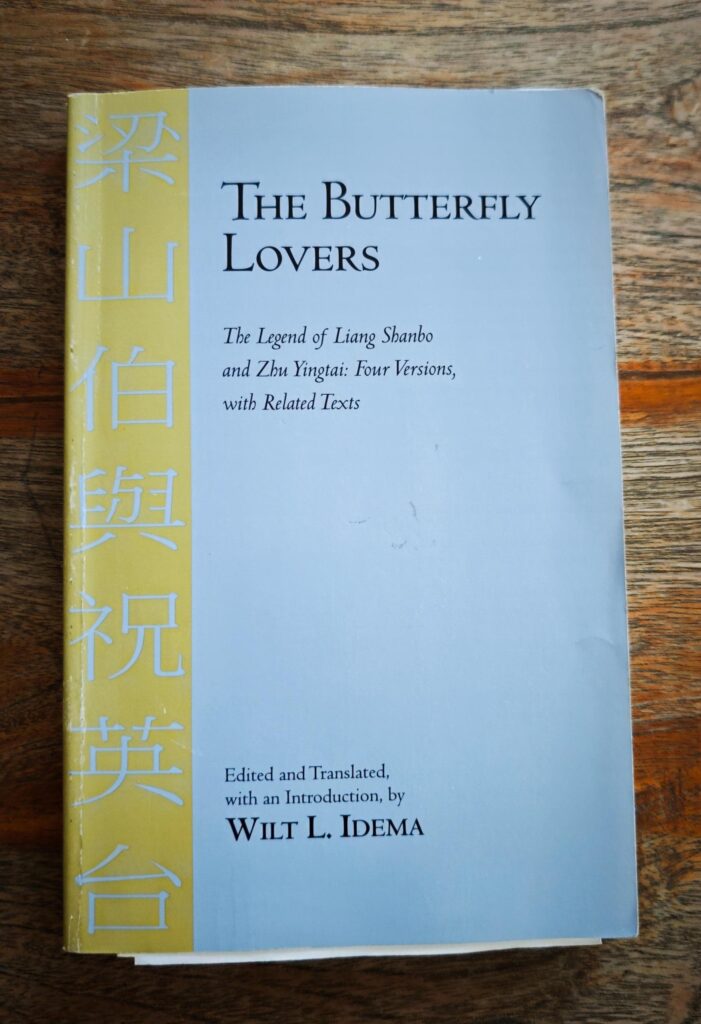
The Butterfly Lovers is the name given to a famous tale of the tragic love of Liang Shanbo and Zhu Yingtai.
According to the book The Butterfly Lovers by Wilt L. Idema, published in 2010, the tale can be traced back to the Song dynasty and most likely the Tang.
In its simplest form, the tale is about a brilliant, rebellious young woman from a wealthy family. Desperate to pursue an education (forbidden to women), she disguised herself as a man.
Liang Shanbo is a sincere but somewhat naive scholar from a poorer background.
They met on the road to Hangzhou and became sworn brothers at the study academy.
They study together for three years, during which Zhu falls in love with Liang, but Liang remains unaware that she is a woman.
Zhu is recalled home by her father. Before leaving, she tried to reveal her identity and feelings to Liang indirectly (e.g., hinting she has a “sister” exactly like her whom Liang should marry), but Liang didn’t grasp the meaning.
Back home, Zhu’s parents arrange her marriage to Ma Wencai, the son of a powerful official. When Liang finally visits Zhu and discovers she is a woman and betrothed to another, he is heartbroken.
Liang died of grief and despair shortly after. He was buried beside the road.
On her wedding day, as Zhu’s wedding procession passed Liang’s grave, a fierce storm erupted. The grave cracked open. Zhu threw herself into the grave, which then sealed shut.
Moments later, two beautiful butterflies emerged from the grave, flying freely and inseparably together, symbolizing the lovers’ eternal union and freedom from societal constraints.
This tale has been interpreted in modern China as an indictment of China’s traditional family system that denied girls an education and denied them free love, and the tragic ending as proof that equality and freedom cannot exist in the traditional Chinese family system.
The poser I pose is this: Is this the moral behind the tale, bearing in mind it was composed back in the Tang? Should we interpret this tale with post-20th-century eyes?
The tale is called the Butterfly Lovers. In earlier versions of the tale it is the gown of Zhu, torn to shreds, which turned into butterflies. In later versions, it is the souls of the two deceased lovers that turn into butterflies.
The tale inspired the Butterfly Lovers Violin Concerto, one of the most famous Chinese works of orchestra.